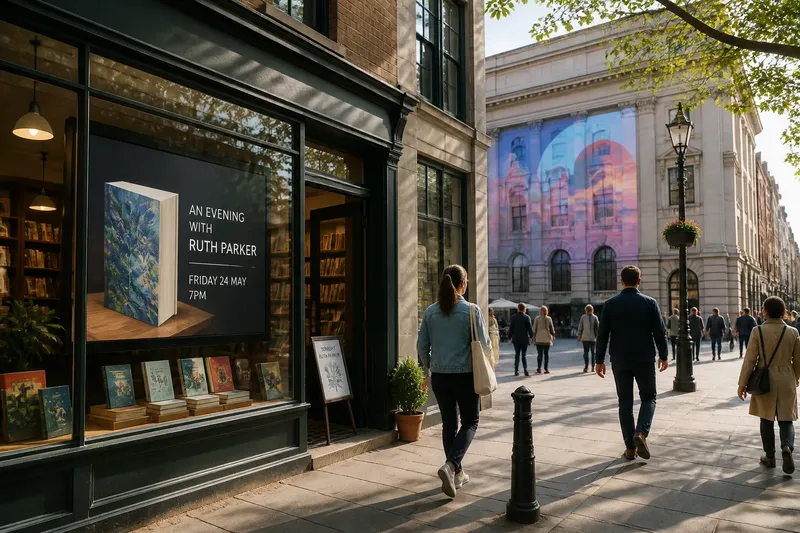
Before the Moving Image: How the City Sign Changed
Read the changing city sign through its lettering, materials, placement and light, while separating visible evidence from assumptions about its history.
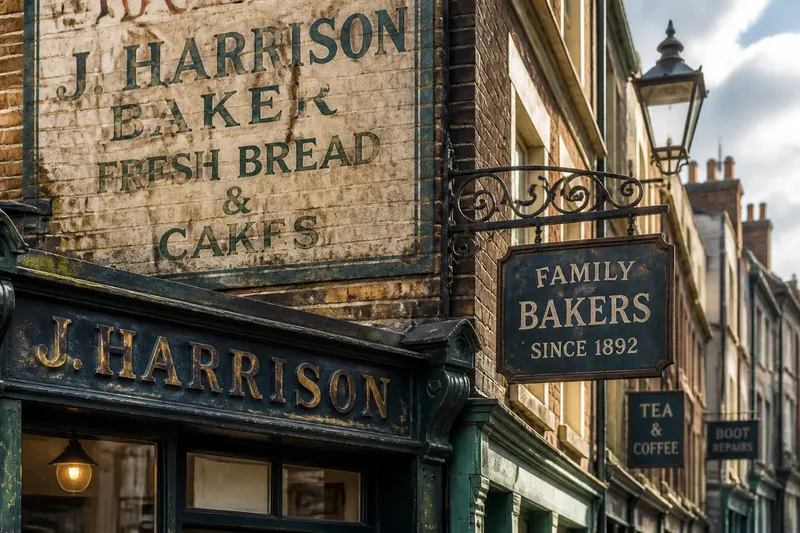
The common mistake when reading an old street sign is to treat it as decoration. That overlooks its practical evidence: how a business wanted to be found, what its makers could produce and how passers-by were expected to look. The changing city sign is not a single march from paint to pixels. It is a layered history, with forms appearing at different times and continuing to coexist.
There is no universal city-wide sequence to follow. A surviving sign can suggest how a particular frontage worked, but it rarely establishes a precise date or a wider historical pattern on its own. Read what is visible first: words, materials, position, light and images. Treat any chronology as a provisional interpretation unless a dated photograph, business record or building document supports it.
What does the lettering tell you first?
Start with the letters, not the presumed age of the building. Note whether they are painted directly on brick, cut into stone, fixed as separate metal characters or printed on a board. Each form makes a different kind of claim. Painted words can cover a broad wall without adding much depth; raised letters cast shadows and remain legible from an angle.
Look at the information. A sign may name a shop, identify a trade, give directions or state a service. A name alone asks the passer-by to recognise or remember it. A sign that says what is sold can work for a stranger. Fixed lettering could serve regular local routes, but it could also address travellers near a station, market or busy road. The intended audience must be inferred from the site, not assumed from the lettering alone.
Then check how the words are arranged. Large initial capitals, compact lines and generous gaps set a reading order. A trade name might be prominent, with a smaller line explaining the goods beneath it. The sign is a small public argument about what deserves attention.
How did fixed signs meet the street?
Follow the sign’s physical relationship to the building. A fascia above a doorway addresses people already close to the frontage. A projecting sign turns towards someone approaching along the pavement. Lettering high on a wall can be seen from farther away, though its details may be harder to read. These placements reveal likely viewing distances without establishing when a sign was made.
Materials shape both appearance and maintenance. Wood can be carved or painted; metal can be cut, cast or enamelled; glass can carry lettering on its surface or behind it. Edges, fixings and faded patches may show whether a sign was renewed in place or replaced as a complete panel. Read these clues cautiously: repair and reuse can leave several layers on one surface.
Say you find a bakery on a narrow street, with painted words above its door and a small projecting board at the corner. The placement suggests that one sign served people near the entrance while the other faced those turning into the street. If a lit panel has been added, it may have extended visibility after daylight, but the sign’s date and purpose would still need other evidence. Like a palimpsest, the frontage can preserve traces without telling you exactly when each was written.
What changed when signs began to glow?
Illumination let a sign remain visible after dark, but its arrival was not one clean transition. A lamp directed at a painted board could light existing words. An internally lit sign made its face visible from within. Neon tubing later offered another way to form luminous words and outlines. These methods overlapped, and the order in which they appeared on any particular street needs local evidence.
Do not assume every illuminated sign was meant to be read quickly or from far away. Some carried a business name; others relied on a recognisable emblem, colour or outline. Glow could separate a frontage from neighbouring façades, but placement, contrast and legibility still mattered. A bright surface with cramped lettering can be as unhelpful as a dim one.
Look for the distinction between lighting the sign and making the sign out of light. In the first case, a lamp falls on a separate surface. In the second, luminous letters or shapes become the display. The difference is useful for describing what you see, though it does not by itself date the sign.
When did the sign start to behave like an image?
Illustrated signs are not a reliable marker of one particular period. A painted trade emblem, product picture or figure could communicate without requiring every passer-by to read the same words. An image might explain a service, mark a familiar name or make a frontage easier to recognise. Fixed images broadened a sign’s vocabulary but presented one arrangement at a time.
Mechanical and illuminated devices could introduce movement through rotating elements, changing light patterns or sequences of images. Electronic displays later made it possible to alter content without replacing a painted board or printed panel. The precise arrival and adoption of these forms varied by place. On an individual frontage, dated photographs, surviving equipment or business records are stronger evidence than appearance alone.
Notice whether a display changes what it shows or only how it is seen. A fixed painted image can be vivid and carefully composed, but its content stays put. A moving or changeable display can present a sequence, while giving viewers less time with each message. The distinction is about time as much as technology.
How can you read a city sign in sequence?
Use these observations to keep visible evidence separate from guesses. Each result points to a next step, not a date by itself:
- Check the form. If the sign is painted, carved, applied, projecting, illuminated or image-based, describe that feature; if the construction is obscured, record what is visible and avoid assigning a more specific form.
- Check the message. If it names a business, trade, product or direction, separate those details in your notes; if the wording is incomplete, mark the reading as uncertain rather than filling in missing letters.
- Check the viewpoint. If the sign faces a doorway, pavement approach or corner, note the likely audience; if the viewing direction is unclear, compare its orientation with nearby routes before deciding.
- Check the light source. If a lamp illuminates a separate surface, describe it as externally lit; if the letters or face appear luminous, record that distinction, and if the source is hidden, leave the method unresolved.
- Check for layers. If faded paint, covered lettering or altered fixings are visible, note possible repair or reuse; if there is no clear evidence, do not infer replacement from age or style alone.
- Check for change. If the display remains still, record a fixed image; if it changes at intervals or plays a sequence, describe that observed behaviour, and if you cannot see it change, do not assume it is animated.
A rusted bracket does not establish when a sign was installed. A patch of brighter paint may mark repair rather than a new owner. If a date matters, compare the physical clues with dated photographs, business directories or building records; if those sources are unavailable, state the uncertainty. Where a sign is protected or attached to a historic building, consult the relevant local authority or a conservation specialist before altering it.
What questions help place a sign in its history?
Why did fixed lettering remain useful?
Fixed lettering is direct and can attach a business name to a building without electricity or a changing message. It has limits: it cannot address darkness on its own, and its content stays the same until someone changes it.
Did illumination replace painted signs?
No single form displaced all the others. Painted lettering, projecting boards, lit boxes and luminous tubing can coexist, sometimes on one street. The mix on a particular frontage reflects local choices and circumstances, which need evidence beyond the sign’s appearance.
What made an image-based sign different?
An image could identify a product or trade without relying wholly on words. A changing image added sequence, letting the sign present content over time rather than as one fixed composition.
Can a sign’s age be read from its material alone?
Not reliably. Materials can be reused, repainted or replaced, and a newer sign may imitate an older style. Read material alongside construction, lettering, placement and evidence of alteration, then seek dated records if a firm chronology matters.
What remains visible after the technology changes?
Older ways of using a frontage can persist beneath newer equipment. A modern display may occupy a place where painted lettering once named a shop; a projecting sign may still catch the eye of someone approaching from a cross-street. Even a moving image must occupy a site, face a viewer and remain legible against nearby surfaces.
The changing city sign is best read as a history of overlapping capacities: fixed words identify, images can explain, light extends visibility and movement introduces time. That is a useful frame, not a universal timetable. When a bright display catches your attention, look beside it for an old outline, bracket or painted layer. Those traces can show how the frontage has been used, even when they cannot tell you exactly when it changed.