A Slow Walk Past Public Displays
A slow walk past public displays helps you notice placement, content and setting, so familiar screens make more sense as part of the street around them.
The common mistake on a familiar route is to notice a public display only when it flashes, advertises something you want or blocks the view. That leaves the quieter evidence behind: where the screen sits, what it leaves visible, and how the pavement, shopfronts and passing traffic change its character. A slow walk past public displays offers a modest remedy. It costs little more than a few minutes of attention, and it can make an ordinary street feel newly legible.
What should a slow walk past public displays look for?
Choose a route you already know, such as the walk from a bus stop to a library or the stretch between a local shop and a junction. Familiarity matters. You are not trying to turn the outing into an expedition; you want a steady baseline against which small details can register.
For this imagined walk-through, say Mara takes the usual route from a bus stop to a neighbourhood library. She decides not to photograph or catalogue every screen. Instead, she walks at an unhurried pace and pays attention to three things: position, content and setting. At the start, she expects to see a few advertisements. By the end, she has a more useful picture of how the displays sit within the route.
Keep the exercise observational rather than evaluative. A screen need not be attractive or useful to be worth noticing. You are asking what it does to the place as encountered from the pavement, not issuing a verdict on the people who installed it.
Where does each display sit in the route?
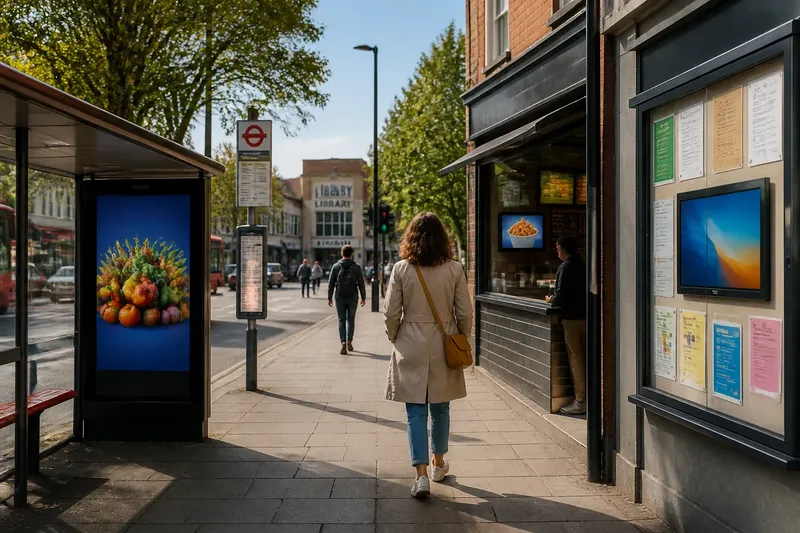
Mara first notices a display beside the bus stop. It faces the waiting area, rather than the carriageway, and its frame is partly screened by a shelter panel. The placement suggests an audience with a little time to spare. A few streets later, a smaller screen sits high in a takeaway window, angled towards people approaching from the corner. The second display meets a moving pedestrian, not a waiting one.
Notice the screen’s height, orientation and distance from the usual walking line. Look for whether it faces a crossing, a queue, a seating area or a shop entrance. A display beside a place where people pause may be encountered differently from one positioned along a stretch where everyone is hurrying through.
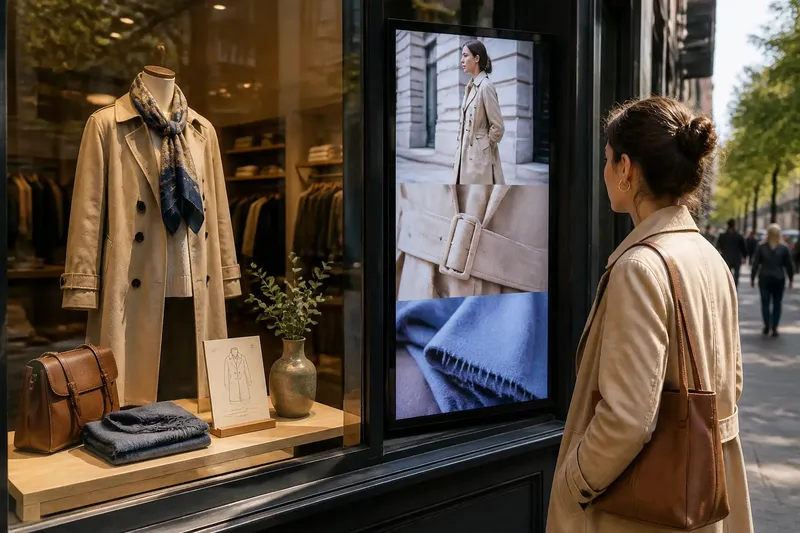
Also note what is around it. A screen can sit beside a blank wall, compete with handwritten notices, appear behind glass or share a façade with several signs. These neighbours affect what draws the eye and what gets overlooked. The point is not to decide which display wins, but to record the visual company it keeps.
What does the display show, and how does it change?
On her walk, Mara sees a council notice, a food advertisement and a short loop of abstract colour. She does not need to remember every word. She notes the broad kind of content and whether it changes while she is nearby. If a display is static, that is a useful observation too; movement is not the only feature that shapes attention.
Content can seem different according to its timing and surroundings. A public notice beside a library may feel like part of the place’s everyday information. The same style of notice in a brightly branded shop window might read more like an interruption. That response belongs to the whole scene, not just to the screen’s message.
Watch, where convenient, for how the display behaves in relation to people passing. Does a change of image coincide with someone slowing down? Do pedestrians glance at it and continue, or does it hold someone near a doorway? These are brief, visible moments, not proof of what anyone thinks. Keep your attention on the scene and avoid staring at individuals or making assumptions about their reasons.
How does the surrounding place alter the feel?
At the library corner, Mara finds a display behind glass among printed event notices. The screen’s moving image draws her eye, but the paper notices make it feel like one item on a shared information board. Near the junction, another display appears above a run of closed shutters. With fewer details around it, the same kind of movement feels more exposed and prominent.
This is the route’s central lesson: a public display is not experienced in isolation. Pavement width, nearby doors, shop activity, street furniture and the pace of foot traffic all contribute. A screen can seem welcoming when it accompanies a place to pause and rather abrupt when it dominates a narrow passage. Those impressions are contingent; another passer-by may read the scene differently.
Use an everyday analogy. A display is a little like a lamp on a table: the object matters, but so does the room, the surface beneath it and what else is in view. On a street, the “room” keeps changing as buildings, movement and sightlines come into play.
What should you note without turning the walk into homework?
Mara makes a short note at the library, after leaving the busy pavement. She records the bus-stop screen as facing a waiting area, the takeaway display as aimed towards approaching pedestrians, and the library-corner screen as sharing space with paper notices. She adds that the junction display felt more prominent against closed shutters. This is enough to compare the beginning and end of the route without pretending to have conducted a formal survey.
- Position: note whether the screen is beside a queue, entrance, crossing, seat or open stretch of pavement.
- Direction: record which way it faces and who is likely to encounter it along the ordinary walking line.
- Content: describe the broad subject or purpose, without copying personal details or trying to preserve every message.
- Movement: note whether the image changes, stays still or repeats a visible sequence.
- Surroundings: mention nearby signs, windows, shutters, trees, street furniture or other features that shape the view.
- Passing activity: describe general patterns such as people waiting or continuing past, rather than identifying individuals.
These notes are prompts, not a scoring system. If you find yourself rushing to record everything, put the notebook away and continue walking. The route is the subject; the notes are only a reminder of what you noticed.
What questions help make sense of the walk?
Should I walk the route at the same time each time?
For a first observation, choose a time when the route feels ordinary to you. If you later repeat the walk at another time, record that difference rather than treating the scenes as directly equivalent.
Do I need to read every message on a display?
No. A broad description is usually enough to notice whether the screen carries public information, advertising or changing imagery. Reading every line can distract from placement and the surrounding street.
What if a display is switched off?
Note its position and appearance without guessing why it is dark. An inactive screen remains part of the street scene, though its effect may differ from the effect of a moving image.
Can I take photographs during the walk?
You can choose to photograph a display, but a note may be less intrusive and sufficient for this exercise. Respect people’s privacy, avoid obstructing the pavement, and follow any local rules or site notices that apply.
What changed for Mara by the end?
By the library, Mara has not discovered a hidden system or proved that one screen is better than another. She has learned to distinguish between displays encountered while waiting, those aimed at people in motion, and those folded into a façade with other information. She has also noticed that a screen’s visual weight can rise or fall with the activity and surfaces around it.
That is a useful result for anyone who wants to read a familiar route more carefully. On your next slow walk past public displays, begin with where each one sits, then look at its content and the street that contains it. The most revealing observation may be what the screen shares the view with, or what disappears when your attention turns towards it.